So, What Is Radio Contesting Anyway?
If you’re not a radio amateur, the idea of a radio contest probably sounds a little strange.
There are no cars, no stadium, no audience — just people sitting in front of radios, wearing headphones and trying to contact as many other radio stations as possible.
So what exactly is going on?
📻 Think of it as a worldwide game of „Can You Hear Me?“
Amateur radio operators — often called hams — use radio equipment to communicate with people all over the world.
During a contest, thousands of them get on the air at the same time.
The basic idea is simple:
Make as many valid radio contacts as possible within a limited period of time.
A contact is called a QSO in ham-radio language.
Depending on the contest, you might have 24, 48 or 36 hours to make contacts. Different contests have different rules, but generally you are trying to:
- contact as many stations as possible,
- contact stations in as many different countries or geographic areas as possible,
- and sometimes collect special information from each station.
Every valid contact can earn points, and the final score is calculated according to the rules of that particular contest.
It’s a bit like collecting points in a worldwide game — except your „playing field“ is the radio spectrum.
🌍 And the other players can be anywhere
This is what makes it particularly interesting.
One minute you’re talking to somebody a few hundred kilometres away. A few seconds later, you might be communicating with someone in Japan, Brazil, South Africa or the United States.
Radio signals don’t simply travel in a straight line around the world. Depending on the frequency, time of day, solar conditions and the state of the Earth’s ionosphere, signals can travel enormous distances by bouncing or refracting through the upper atmosphere.
And that means conditions can change constantly.
A station that is booming into your receiver one minute can completely disappear a few minutes later.
⚡ Where does the competition come in?
Imagine there are thousands of stations on the air, all trying to contact each other.
Everyone is calling at once.
So the operator has to:
listen → find a station → call → receive the response → log the contact → immediately move on to the next one.
And then do it again.
And again.
And again.
For serious contesters, this can mean hundreds or even thousands of contacts during a single weekend.
The computer keeps track of everything: who was contacted, when, on which frequency, whether the contact was valid, the points earned, multipliers, and eventually the calculated score.
It’s surprisingly intense.
🖥️ So what is DF7EE doing?
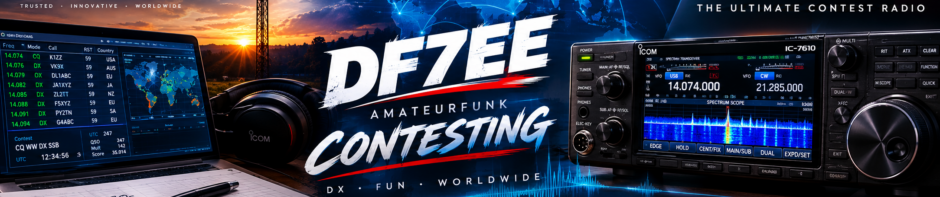
DF7EE is Helmut’s amateur-radio callsign.
A callsign is essentially the radio equivalent of a name or identifier. Instead of saying „Hi, I’m Helmut“ over the radio, he identifies himself with his callsign:
DF7EE
Helmut is an experienced radio operator and contester.
That means contesting isn’t just something he occasionally tries for fun — he has spent many years operating contests, improving his station setup, studying propagation and working on the techniques needed to make contacts quickly and accurately.
In a contest, he can sit in front of several computer screens and radios for many hours, continuously searching for stations to work.
🏠 And sometimes he doesn’t operate from home
This is where the LX7I story comes in.
LX7I is a very powerful amateur-radio station in Luxembourg, equipped with excellent antennas, radios and other equipment.
Helmut sometimes gets permission to operate from this station.
That gives him access to a much more capable setup than most people have at home.
In the WW DIGI contest described in the article, for example, he was operating remotely from his home computer while controlling equipment at LX7I.
So physically, Helmut could be sitting at home in Germany — while his radio station was transmitting from Luxembourg.
📡 Why do the antennas matter so much?
For a non-radio person, it’s easy to think:
„If you have a powerful radio, you can just talk to anyone.“
Unfortunately, it’s not that simple.
The antenna is enormously important.
Think of it a little like trying to communicate with someone across a huge valley.
A weak flashlight isn’t going to help much. But a carefully designed spotlight aimed in the right direction can make a huge difference.
Radio antennas can be designed to send and receive signals more effectively in particular directions.
At a large contest station such as LX7I, there can be multiple antennas covering different bands and directions.
This allows the operator to quickly switch between them depending on where they are trying to reach.
🌐 And then there is propagation…
This is probably the strangest part for someone new to the hobby.
Whether Helmut can hear and contact a particular part of the world depends heavily on radio propagation.
The Earth’s atmosphere effectively becomes part of the communication system.
Solar activity, time of day, frequency, atmospheric conditions and other factors can determine whether a signal from Europe can reach North America, Asia, Australia or somewhere else.
That’s why a contest can start with fantastic conditions and then suddenly become much quieter.
And that’s exactly what happened during this year’s WW DIGI contest.
In 2025, Helmut made almost 2,000 contacts during the contest.
In 2026, despite having essentially the same motivation and an excellent station, propagation and participation were significantly worse.
You can’t control the atmosphere.
You just have to work with what you’ve got.
🗺️ Why all the maps and statistics?
Because contesters are, well… contesters. 😄
Maps are a great way of seeing where your signals are reaching.
During the contest, Helmut was monitoring real-time reports from other stations around the world.
The map essentially showed:
„Where can people hear me right now?“
And that information can help an experienced operator decide where to concentrate his efforts.
After the contest, the statistics become part of the fun too:
How many contacts?
Which countries?
Which continents?
What score?
What ranking?
And eventually:
How did I do compared with everyone else?
🏆 So is DF7EE a professional?
No.
That’s another important thing to understand.
Amateur radio is a hobby, not a professional radio service.
Helmut isn’t being paid to make these contacts.
He does it because he enjoys the technology, the challenge, the competition, the international aspect — and, in his case, apparently the opportunity to spend a ridiculous number of hours staring at radio screens! 😉
For a serious contester, a contest combines several hobbies into one:
technology + computers + antennas + radio science + geography + strategy + competition + endurance.
And underneath all of that is simply the fun of making a connection with another person somewhere else in the world using radio waves.
❤️ And that’s the part that matters
For someone outside the hobby, 2,000 radio contacts might sound like 2,000 numbers in a spreadsheet.
For a ham radio operator, every one of those contacts represents something different.
A difficult signal finally breaking through.
A country you’ve never contacted before.
A station on the other side of the planet.
A perfect moment of propagation.
Or simply two people, thousands of kilometres apart, managing to hear each other through the noise.
That’s what makes contesting so addictive.
73 — the traditional amateur-radio way of saying goodbye — from DF7EE.
Are you interested in contesting? JOIN THE RRDXA!